What is a port catchment, and why do two unrelated suppliers share one?
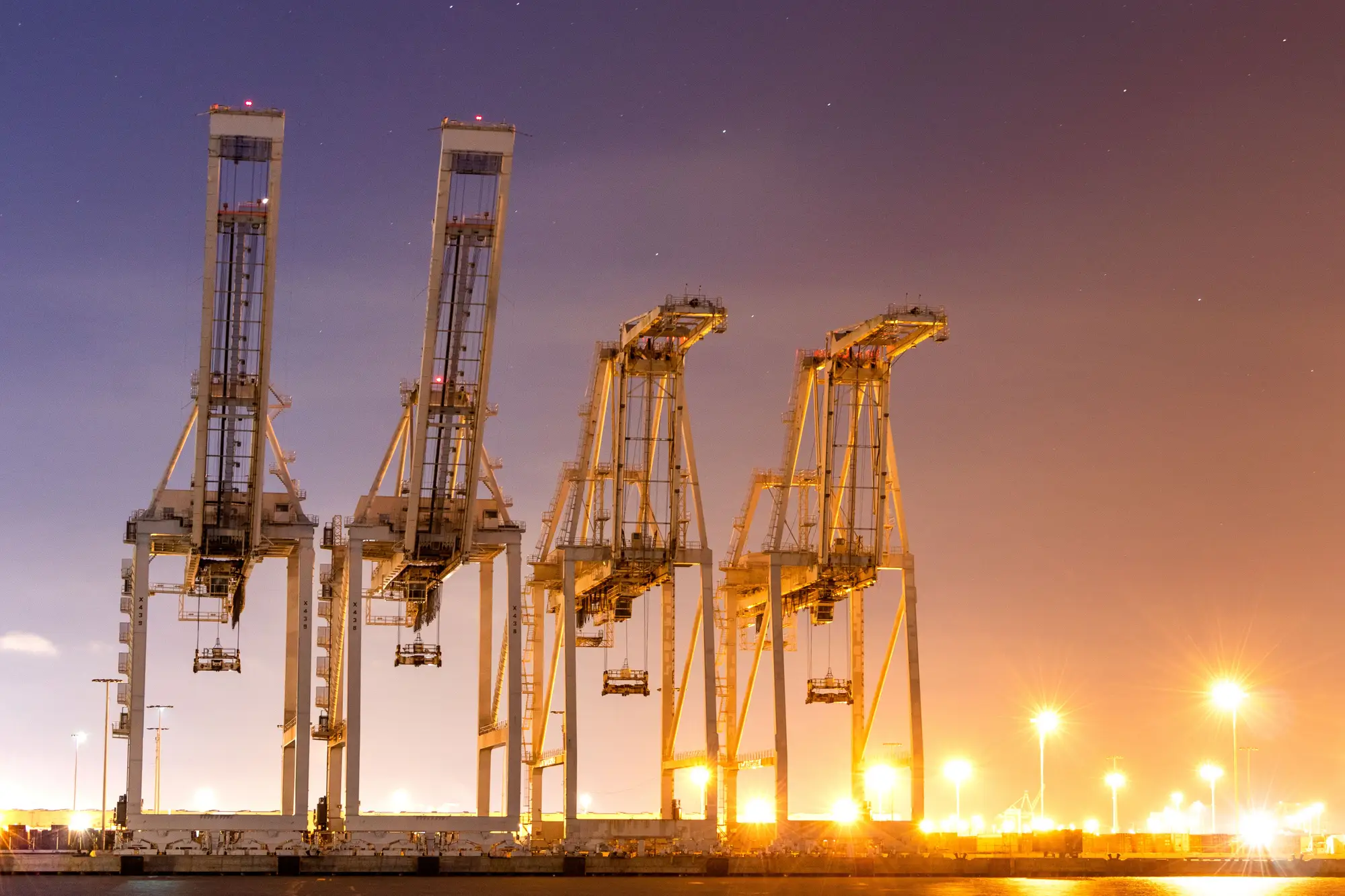
A port catchment is the set of suppliers whose outbound freight funnels through the same port, terminal, or feeder route, regardless of where their factories sit on a map. Two vendors can be hundreds of kilometers apart, sourced through different agents, selling different components, and still clear customs through the same gate because that gate is the nearest deepwater option for their region.
That's the part that never shows up on a vendor list. Your sourcing records say "Vendor A, Shenzhen" and "Vendor B, Dongguan." Nothing in those two lines tells you both ship through Yantian. The address field answers where the factory is. It doesn't answer where the freight goes next, and that second question is the one that matters when a port shuts down.
Why unrelated suppliers end up sharing one gate
A handful of hard constraints decide where a container port can exist at all: deep water, rail or highway access inland, and room for a customs post. Only so many stretches of coastline have all three. Suppliers in a region don't choose a port so much as inherit one, the one their freight forwarder already uses, the one whose shipping lines serve their lanes, the one that's simply closest.
So a packaging supplier and an electronics subassembler with no commercial relationship, no shared ownership, and no reason to ever appear on the same spreadsheet tab can still both depend on the same terminal, the same dredged channel, the same customs post. Add a regional industrial cluster into the mix, the kind that grows up around a port because land and labor are cheap near the water, and you get two more vendors funneling through the identical gate for the identical reason.
This sits differently in your risk register than ordinary supplier concentration. You can single-source a part and know it. Port catchment risk hides inside multi-sourcing, because the whole point of splitting an order across two vendors is to remove a single point of failure, and that only works if the two vendors don't share one further upstream.
What this looks like when it goes wrong
A typhoon closes a port for four days. A labor dispute idles the cranes for two weeks. A channel runs aground and blocks the lane for most of a week, the way it happened at Suez in 2021. None of those events care about your vendor list. They care about geography, and geography is exactly what a spend-by-vendor spreadsheet doesn't encode.
The category manager finds out their dual-source strategy for a critical component wasn't really dual-source at all. Both vendors cleared the same port. The redundancy they'd built into the category existed on paper and nowhere else.
Mapping it before the event, not after
The fix is treating supplier geography as geography: plotting where the factories, the industrial parks, and the port catchments sit, so the overlap is visible before a closure forces you to discover it. Sourcing Concentration turns a category's supplier list into exactly that kind of concentration map, once a year, so the cluster nobody had flagged shows up as a cluster on a plan instead of as a surprise after the fact.
If your category's dual-sourcing plan has never been checked against where the freight actually moves, it's worth looking at one of these maps before the next port disruption does the checking for you.